Women are 64% of the Brazilian architects and urban planners
But when thinking about architecture, few people know or remember the names of women in this activity. Although they are majority, they are still paid less for their work and occupy fewer leadership positions.
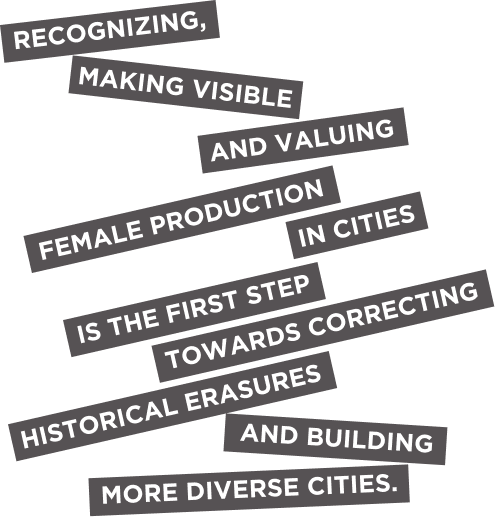
The fact that men are the protagonists in building cities means that women’s needs are often overlooked. Designed by men, most city master plans and urban policies project the city according to an economic and masculine logic, valuing production activities, paid work and consumption. Women are the ones who most walk and take public transport. On the other side, they take few decisions and are less heard about their needs in cities.
Where are the women
in Rio de Janeiro City?
Did you know that 83% of streets in São Paulo are named after men?
In Rio de Janeiro, there is a municipal law (2.906/1999) that made it “obligatory to alternate the genders, in equal proportions, of the names of male and female personalities”.2 But until 2016, only 14.9% of Rio de Janeiro’s streets had female names.
Rio de Janeiro has 2,000 monuments, but fewer than 20 are named after women. This is also a way of erasing and devaluing the participation of women in society and in the cities.
Do you know where are the buildings built by women? Or which monuments pay tribute to women?
What would the city be like if the names of streets, avenues and squares would recognize the contribution and presence of women?
Rename the public spaces after Brazilian women who fought and fight for rights and equality.
Beatriz Nascimento
(1942-1995)
Historian, teacher, screenwriter, poet and activist for human rights of black people and women. She was one of the country’s leading intellectuals, with fundamental contributions to understanding black identity as an instrument of self-affirmation.
Bernadete Pacífico
Ialorixá (priestess and leader in the Candomblé religion), matriarch of the Pitanga dos Palmares quilombo (quilombos are groups of black people formed by the remnant societies of former enslaved people) and former Secretary of Policies for the Promotion of Racial Equality in Simões Filho, Bahia. She had been denouncing the threats she received and the persecution of quilombolas (inhabitants of a quilombo), and was shot dead on August 17, 2023.
Cida Bento
Brazilian psychologist and activist, director of the Center for the Study of Labor Relations and Inequalities (CEERT), which works to reduce racial and gender inequalities in the workplace. In 2015, she was named one of the 50 world’s most influential people in the area of diversity by The Economist magazine.
Creuza Oliveira
Honorary President of the National Federation of Domestic Workers. She was the first union leader in this category to be honored with the title of Doctor Honoris Causa in Brazil by the Federal University of Bahia.
Eliete Paraguassu
Black woman, solo mother, shellfish gatherer, fisherwoman and quilombola from the Maré Island, in Salvador. An activist in the fishing movement for over 20 years, she fights in defense of black people, the environmental and the buen vivir (well living).
Erica Malunguinho
Brazilian educator, artist and politician. In 2018, she was elected state deputy for São Paulo, becoming the first transgender woman in the Parliament of the state São Paulo.
Erika Hilton
First black and transgender federal deputy elected in Brazil’s history, she was the most voted councillor in the country in 2020. For two years she was the president of the Human Rights Commission of the São Paulo City Council.
Joênia Wapichana
She is a lawyer, the first indigenous woman to practice law in Brazil, and also the first indigenous woman to be elected a federal deputy in Brazil (2019-2023). She is the current president of FUNAI (National Foundation for Indigenous Peoples).
Keila Simpson
President of the National Association of Transvestites and Transsexuals (Antra). She has been an activist in the LGBTQIAP+ movement since 1990. She has already been vice-president of the Brazilian Association of Lesbians, Gays, Bisexuals, Transvestites, Transsexuals and Intersexuals (ABGLT) and, in 2013, received the National Human Rights Award.
Laudelina de Campos Melo
(1904-1991)
A defender of women’s rights, she founded the first domestic workers’ union in Brazil. Her work was vital to assure this category of workers the right to a work permit and the social security.
Lélia Gonzalez
(1935-1994)
Brazilian intellectual, author, politician, teacher, philosopher and anthropologist. A pioneer in studies on black culture in Brazil and co-founder of the Institute for Research of Black Cultures in Rio de Janeiro, the Unified Black Movement and the Olodum (an Afro-Brazilian drum school and NGO in the city of Salvador, Bahia).
Luiza Bairros
(1953-2016)
She had a degree in Public Administration and a PhD in Sociology from the University of Michigan (USA). She was one of the main figures in the Unified Black Movement (MNU). Former Minister of the Secretariat of Public Policies for Racial Equality, a position she held between 2011 and 2014.
Puyr Tembé
She is currently the Secretary of Indigenous People of the State of Pará, was president of the Federation of Indigenous People of the State of Pará (FEPIPA) and is co-founder of the National Articulation of Indigenous Women Warriors of Ancestry (ANMIGA). She is an organizer of the Indigenous Women’s Marches.
Rose Marie Muraro
(1930-2014)
In the 1970s, she was one of the pioneers of the feminist movement in Brazil. Writer, intellectual, author of more than 40 books on feminism, women’s rights and related issues. She also worked as an editor on 1.600 titles.
Sandra Braga
A rural farmer, she is a member of the Black Coalition for Rights and the Black Women’s Collective of CONAQ – National Coordination for the Articulation of Rural Black Quilombola Communities. She is a member and leader of the Quilombo Mesquita in the state of Goiás.
Selma Dealdina
Quilombola woman from Angelim III, Territory Sapê do Norte, in the state of Espírito Santo. She is a member of various civil society organizations committed to the quilombola and the anti-racist struggle. She is the Executive Secretary of the National Coordination for the Articulation of Black Rural Quilombola Communities (CONAQ).
Sonia Guajajara
She has a degree in Literature and Nursing and a postgraduate degree in Special Education. Internationally recognized for her struggle to defend the rights of indigenous peoples and socio-environmental causes. She is currently Minister for Indigenous People in Brazil.
Sueli Carneiro
(1942-1995)
Philosopher, writer and anti-racist activist in the Brazilian black movement. She has a PhD in philosophy from USP and is the founder of Geledés – Black Women’s Institute, being considered one of the most important thinkers of black feminism in Brazil.


